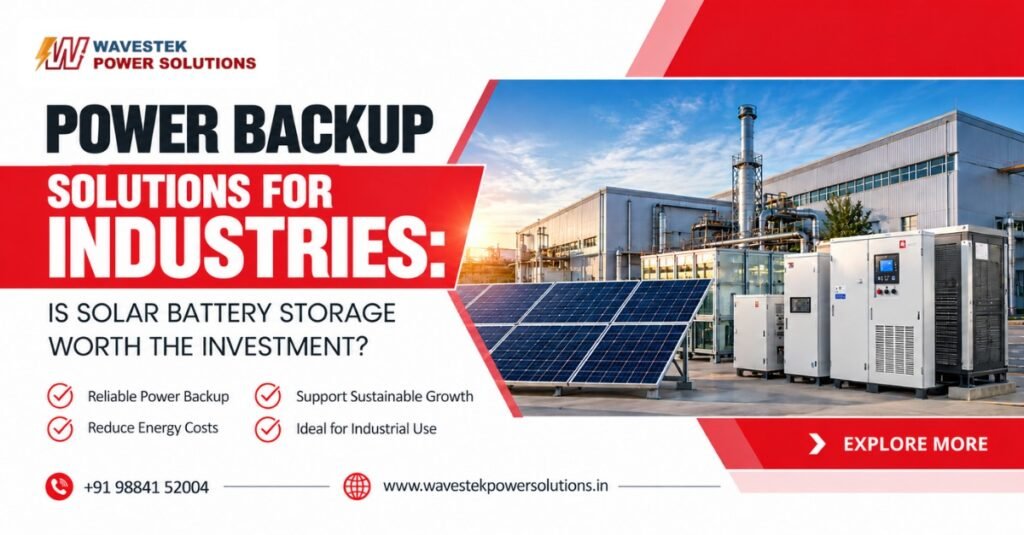
Power Backup Solutions for Industries: Is Solar Battery Storage Worth the Investment?
Imagine your factory has plenty of sunlight throughout the day, but electricity costs continue to rise. At the same time, unexpected power cuts interrupt production and delay important work. What if your business could store solar energy and use it when needed? Solar battery storage is becoming an option for businesses looking to manage energy consumption and improve power reliability. But is it really worth the investment for industries? Let’s explore how solar battery storage works, its benefits, its limitations, and what businesses should consider before choosing a system. What Is Solar Battery Storage? Solar battery storage allows businesses to store electricity generated by solar panels and use that energy later. Instead of using all the solar power immediately, a suitable system can save excess energy for evening operations or other periods when solar generation is low. A typical solar battery energy storage system includes: Solar panels to generate electricity. A compatible inverter to convert and manage power. Batteries to store usable energy. A monitoring system to track energy generation and consumption. Suitable electrical protection and control equipment. The system configuration depends on your facility’s energy needs and whether you want to reduce electricity costs, provide backup during outages, or achieve both goals. Why Are Industries Considering Solar Battery Storage? For industrial businesses, electricity is an important part of daily operations. A well-planned energy system can help manage power consumption while supporting essential equipment. 1. Reduce Dependence on Grid Electricity Industries that consume large amounts of electricity during the day may benefit from solar power. When solar panels generate more electricity than the facility immediately needs, a battery can store some of that energy for later use. The actual savings depend on your electricity tariff, solar generation, battery efficiency, and the amount of stored energy you can use effectively. 2. Support Operations During Power Cuts Power interruptions can affect production schedules, computer systems, and industrial control equipment. A properly designed solar battery storage system can supply selected loads during an outage. However, not every grid-connected solar installation provides backup automatically. The inverter, battery, electrical configuration, and backup circuits must support this function. For equipment that cannot tolerate even a brief interruption, an online UPS may still be necessary. 3. Manage Peak Electricity Demand Some industrial facilities consume more electricity during particular operating hours. Depending on the tariff structure and system design, stored energy may help reduce grid consumption during expensive periods. Businesses should compare the potential savings with battery costs, conversion losses, and expected battery life before making a decision. 4. Make Better Use of Solar Energy Without battery storage, excess solar electricity may be exported to the grid or curtailed, depending on the installation and applicable arrangements. A battery allows some of that excess energy to be used later. This can be helpful for businesses whose electricity demand continues after solar generation decreases. Is Solar Battery Storage Better Than a Traditional UPS? Both systems support power reliability, but they serve different purposes. Feature Solar Battery Storage Online UPS Main purpose Store energy for later use Provide continuous conditioned power to connected equipment Energy source Often solar panels, with other charging options depending on design Typically mains electricity, with batteries for backup Typical application Energy management and selected-load backup Sensitive equipment and critical loads Backup duration Depends on battery size and connected load Depends on battery configuration and connected load Best suited for Facilities seeking solar energy utilisation and backup Equipment requiring continuous power protection For many industries, combining solar battery storage with an online UPS can be more practical than choosing only one. The battery system can support energy management, while the UPS protects critical equipment from power interruptions. How Much Does an Industrial Solar Battery System Cost? The cost varies depending on the size of the solar installation, battery capacity, battery chemistry, inverter specifications, installation requirements, and electrical upgrades. A small system designed for essential office loads will have different requirements from a system intended to support selected factory machinery. Before requesting a quotation, identify: Your average daily electricity consumption. The equipment that must remain operational during an outage. The number of backup hours required. Your available roof or installation space. Your current electricity tariff and applicable export arrangements. Your budget and expected payback period. Comparing quotations based on the same capacity, usable battery energy, backup load, warranty, and installation scope makes it easier to assess value. Is Solar Battery Storage Suitable for Every Industry? Not necessarily. The right choice depends on how and when your business uses electricity. Manufacturing units: May benefit when daytime solar generation matches production demand and selected loads need backup. Warehouses: Can explore storage for lighting, security systems, communication equipment, and other essential loads. IT companies: May combine solar energy storage with online UPS systems to protect servers and networking equipment. Commercial offices: Can consider office power backup solutions that combine solar generation, batteries, and UPS protection according to their needs. Facilities operating at night: Need careful planning because solar generation is limited after sunset. Battery capacity and charging options become especially important. For high-power machinery, starting currents and load characteristics must be evaluated before deciding whether a battery system can support the equipment. How to Know Whether Your Investment Is Worth It Before installing a solar battery energy storage system, consider the financial and operational benefits together. Calculate your potential savings. Estimate how much solar electricity you can use directly and how much stored energy can replace grid electricity. Check the backup requirement. Determine which equipment needs backup and for how long. Consider battery replacement. Batteries have a limited service life, and replacement costs affect the long-term economics. Review maintenance and warranties. Check the manufacturer’s warranty, operating conditions, and service support. Compare the payback period. Consider the total installed cost, electricity savings, applicable incentives, and ongoing expenses. If your main goal is to protect critical equipment from brief interruptions, an online UPS may be the more appropriate starting point. If you also want to store solar energy and manage electricity consumption,